
How to Read an SDS in Workplace Settings Before Storing Flammable and Corrosive Chemicals?
Key Takeaways
- Reviewing an SDS before storing chemicals helps identify fire risks, corrosive hazards, incompatible substances, and necessary storage conditions.
- Sections 2, 7, 9, and 10 provide essential information for assessing chemical hazards, storage requirements, physical properties, and reactivity.
- Chemical compatibility, storage quantities, container types, and workplace conditions should guide cabinet selection.
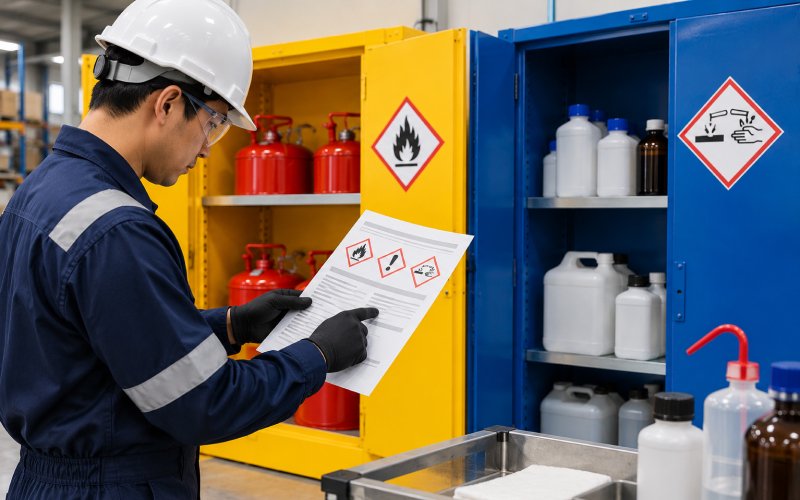
For businesses handling hazardous chemicals, proper storage starts with understanding the risks. Before storing a new substance, businesses must assess whether it is flammable, corrosive, or incompatible with existing chemicals. Knowing how to interpret a Safety Data Sheet (SDS) in workplace settings helps businesses identify these hazards and make informed decisions about chemical segregation and storage requirements.
At Ansac Technology, we recognise that effective chemical storage involves more than selecting a cabinet based on a product label. Drawing on our experience supporting workplace safety requirements, we explain how to interpret key SDS sections and translate their information into practical storage decisions.
What Can an SDS Tell You About Chemical Storage?
An SDS provides standardised information about a chemical’s hazards, properties, handling requirements, and emergency precautions. For storage planning, knowing a substance is hazardous is not enough.
Businesses must understand its specific risks, required storage conditions, and potential reactions with other substances. When reviewing an SDS in workplace environments, we recommend prioritising four sections:
- Section 2: Hazard identification: To review chemical classifications and hazard statements
- Section 7: Handling and storage: To review storage conditions and segregation precautions
- Section 9: Physical and chemical properties: To review flash point, pH, vapour pressure, and other properties
- Section 10: Stability and reactivity: To review incompatible materials and hazardous reactions
Sections 5 and 6 also provide useful information about firefighting measures and accidental-release procedures, particularly when reviewing emergency arrangements.
What Chemical Hazards Should You Identify in Section 2?
Section 2 identifies the chemical’s hazard classification, including relevant pictograms, hazard statements, and precautionary information. We advise businesses to review these details to determine whether the substance presents flammable, corrosive, or multiple hazards that influence its storage requirements.
How Should You Assess Flammable Liquid Hazards?
Start by identifying the chemical’s flammability classification and associated fire precautions. However, a flammable classification alone does not determine the complete storage arrangement.
We recommend assessing the chemical’s quantity, container size, potential ignition sources, and manufacturer-specified storage conditions before selecting a safety cabinet for flammable liquids. The cabinet should be part of a broader fire safety strategy that includes ignition-source control, proper handling procedures, and appropriate storage conditions.
What Should You Check When Storing Corrosive Chemicals?
Corrosive chemicals can damage skin, eyes, and certain storage materials, but their specific hazards and compatibility requirements vary. Before selecting a cabinet with appropriate chemical resistance and spill-containment features, check the chemical’s SDS for material incompatibilities and other hazards.
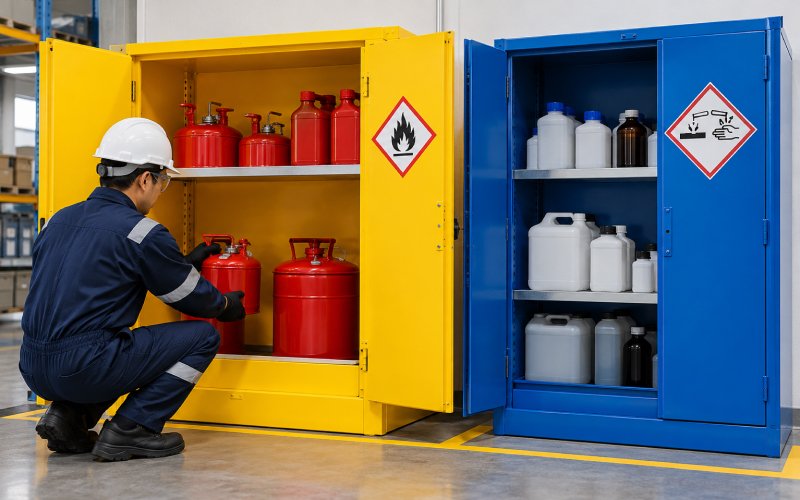
Flammable-liquid cabinets and corrosive-chemical cabinets serve different purposes. A cabinet suitable for one hazard is not automatically appropriate for another. The selected cabinet must match the chemical’s properties, storage requirements, and potential reactions with its construction materials.
What Storage Instructions Should You Review in Section 7?
Section 7 outlines the conditions necessary for safe chemical handling and storage. Before assigning a storage location, businesses should review requirements for temperature, ventilation, moisture, sunlight, ignition sources, and incompatible substances. In practice, the key is to assess whether the proposed storage environment can consistently meet these conditions.
How Can You Match Storage Conditions to the Chemical?
Compare the manufacturer’s storage instructions against actual workplace conditions. For example, placing a flammable liquid inside a cabinet does not eliminate the need to control nearby ignition sources or meet applicable ventilation requirements. These precautions must work together to maintain safe storage conditions and minimise fire risks.
How Can You Check Whether Chemicals Are Compatible for Storage?
Review the incompatible materials and substances identified in Section 7, then compare them against the chemicals already stored in the proposed location. Pay particular attention to chemicals that could react if containers leak, break, or spill. Even when substances are stored in separate containers, a shared spill containment tray could allow incompatible chemicals to mix during an incident.
Which Physical and Chemical Properties Matter in Section 9?
Section 9 provides information about chemical properties that may influence storage risks, including flash point, vapour pressure, pH, and physical state. When reviewing an SDS in the workplace, businesses should interpret these properties alongside the chemical’s hazard classification and manufacturer-specified storage precautions.
What Do Flash Point and Vapour Pressure Tell You About Storage Risks?
Flash point indicates the temperature at which a liquid produces sufficient vapour to form an ignitable mixture. A lower flash point generally means the liquid can pose a fire risk at lower temperatures, so storage temperature and ignition-source control are important considerations.
Vapour pressure adds another consideration by indicating how readily a substance evaporates. Higher vapour pressure may increase the risk of vapour accumulation in enclosed spaces, particularly where ventilation is inadequate. Together, these properties help businesses assess fire risks and determine appropriate storage precautions alongside the chemical’s SDS instructions.
How Does pH Affect Corrosive Chemical Storage Decisions?
pH reflects how acidic or alkaline a substance is, but it does not fully determine its corrosive hazards or compatibility with storage materials. For example, two acids with similar pH values may react differently with certain metals or cabinet components. Businesses should cross-check the chemical’s hazard statements and manufacturer instructions to ensure the selected storage materials can withstand the substance.
How Can Section 10 Help You Identify Incompatible Chemicals?
Section 10 outlines chemical stability, incompatible materials, conditions to avoid, and potentially hazardous reactions. When reviewing this information, we recommend identifying which chemicals must be kept apart, even if they share the same hazard classification. These findings help businesses establish appropriate segregation requirements before selecting storage cabinets.
Why Should Not All Corrosive Chemicals Be Stored Together?
Sharing the same corrosive classification does not make chemicals compatible for storage. For instance, acids and bases can react when mixed, potentially generating heat or releasing hazardous gases. Even different acids may require segregation depending on their chemical properties.
These compatibility concerns become particularly important during leaks or spills. If incompatible chemicals share a containment tray, leaked substances could mix and trigger dangerous reactions. Separate storage areas or dedicated containment measures may therefore be necessary, even when sufficient cabinet space is available.
For spill response, businesses should also review Section 6 of the SDS and confirm that their available chemical spill kit is suitable for the substances handled. Spill response equipment does not replace proper chemical segregation or compatible containment. Employees should follow established emergency procedures and only handle spills within their training and capabilities.
How Do You Translate SDS Information Into Cabinet Selection?
After reviewing the relevant SDS sections, businesses need to assess whether their existing storage arrangements can safely accommodate the chemicals involved. This means looking beyond individual hazards to consider chemical compatibility, storage quantities, and current cabinet limitations.
In practice, an SDS in the workplace should address three key questions:
What Hazards Must the Storage System Address?
Determine whether the chemical presents fire, corrosion, reactivity, or multiple hazards. Avoid selecting cabinets based solely on broad product categories.
Can the Chemical Be Stored With Existing Inventory?
Check the current substances, quantities, container types, and relevant incompatibility information. A cabinet that was suitable initially may become inappropriate as the chemical inventory changes.
Does the Cabinet Suit the Identified Requirements?
When evaluating a safety cabinet, workplace operators should assess its intended application, capacity, construction, and suitability for the chemicals involved. This includes checking whether the cabinet can safely accommodate the quantities stored and whether its spill containment materials are compatible with the chemicals identified in the SDS. For corrosive substances, pay particular attention to chemical-resistant materials and appropriate containment features.
Make SDS Reviews Part of Every Chemical Storage Decision
Effective chemical storage begins before a container enters the cabinet. Reviewing an SDS in workplace operations helps identify hazards, prevent incompatible storage arrangements, and establish appropriate precautions.
When selecting a safety cabinet or storage equipment, businesses should assess its capacity, construction materials, and compatibility with the substances involved. Pay particular attention to whether the cabinet’s shelving and spill containment features can withstand potential leaks without allowing incompatible chemicals to mix.
About Ansac Technology
With over 25 years of experience, Ansac Technology provides safety, environmental, and measurement solutions to businesses across Singapore and Malaysia. Through partnerships with leading global brands, we combine technical expertise, quality products, and end-to-end support to help organisations manage workplace risks, improve operational safety, and meet evolving compliance requirements.
Contact us to find suitable solutions for safely storing flammable and corrosive substances.
Frequently Asked Questions
1. How often should businesses review safety data sheets?
Businesses should review the SDS information relevant to their storage arrangements whenever they introduce new chemicals, change storage conditions or receive updated information from suppliers.
In Singapore, SDSs must be reviewed within five years of their issue date, or when new information or changes in a chemical’s properties become available. Businesses should check that the SDSs they obtain remain current and review their own storage risk assessments when chemical inventories or workplace conditions change.
2. Can flammable and corrosive chemicals be stored in the same cabinet?
Flammable and corrosive chemicals should not automatically be stored together. Some substances may present both hazards, while others may react dangerously when combined. Businesses should review Sections 7 and 10 of each chemical’s SDS to assess compatibility and determine whether separate cabinets or additional segregation measures are necessary.
3. Is an SDS enough to determine the right chemical storage cabinet?
No. An SDS provides essential information about chemical hazards and storage requirements, but cabinet selection also requires a workplace risk assessment. Businesses should consider chemical quantities, container sizes, existing inventory, cabinet construction, and applicable safety regulations before selecting suitable storage equipment. In Singapore, relevant SCDF requirements and licensing obligations must also be considered where applicable.