

Particle Counter: Importance of Particle Counting in Labs and Cleanrooms
In controlled environments like laboratories and cleanrooms, air quality plays a critical role in ensuring product safety and accuracy. Even tiny particles that are invisible to the eye can lead to contamination, product failure, or regulatory issues.
This is where a particle counter becomes essential. It helps detect and measure airborne particles to maintain a clean and controlled environment.
What is a Particle Counter?
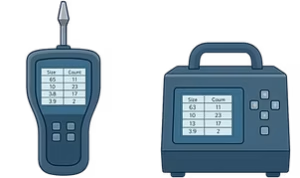 |
A particle counter is a device used to measure the number and size of particles in the air. These particles may include dust, fibers, smoke, and other microscopic contaminants.
By monitoring these particles, businesses can ensure that their environment meets required cleanliness standards. |
Air Cleanliness Level Requirements for Cleanrooms
Cleanrooms are designed to control airborne particles, but not all cleanrooms require the same level of cleanliness. Standards such as ISO 14644 and Good Manufacturing Practice (GMP) define acceptable particle limits based on the type of work being carried out. These classifications are determined by the number of particles allowed in a given volume of air, with stricter environments requiring significantly lower particle concentrations. For example, higher-grade cleanrooms like ISO Class 5 allow only a very small number of particles per cubic metre, while lower classifications permit higher concentrations closer to normal room air conditions.
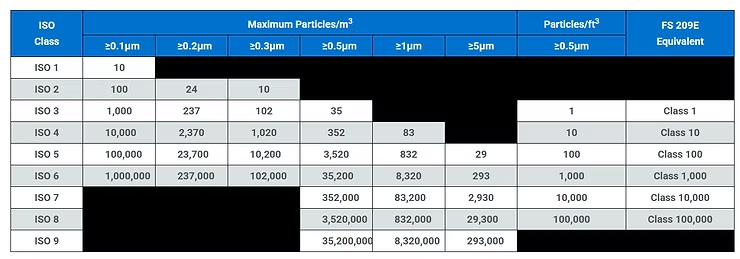
However, achieving a specific classification is only the starting point. Maintaining that level consistently is where most challenges arise, as cleanrooms are constantly influenced by movement, equipment, and daily operations. Even small changes can gradually affect air quality without being immediately noticeable. That’s why relying solely on initial certification isn’t enough ongoing monitoring and proper control practices are essential to keep conditions stable. By staying aware of particle levels and responding early to any fluctuations, businesses can better protect product quality, reduce contamination risks, and ensure continuous compliance.
Why Particle Counting is Important
1. Ensures Product Quality
In industries like pharmaceuticals and electronics, even the smallest contamination can damage products. Particle counting helps maintain consistent quality.
2. Supports Regulatory Compliance
Cleanrooms must meet strict standards such as ISO classifications. Regular particle monitoring ensures compliance with these requirements.
3. Early Detection of Contamination
A particle counter helps detect issues before they escalate, reducing the risk of costly product recalls or downtime.
4. Cleanroom Validation
Before a cleanroom can operate, it must be validated. Particle counting is a key part of this certification process.
Where is Particle Counting Used?
 |
 |
 |
 |
|---|---|---|---|
| Cleanrooms (Pharma, Semiconductor, Biotech) | Laboratories | Hospitals and Healthcare Facilities | Food Manufacturing Environments |
Choosing the Right Particle Counter
With so many options available in the market, choosing the right particle counter can feel a bit overwhelming especially if you’re not dealing with this equipment on a daily basis. The truth is, there’s no one-size-fits-all solution. The right choice really depends on your environment, how often you need to monitor, and how critical your cleanliness levels are.
For smaller labs or facilities that only require periodic checks, a portable particle counter might already be sufficient. It’s flexible, easy to use, and gets the job done when you need quick validation. On the other hand, if you’re managing a cleanroom with stricter requirements or continuous production, relying on occasional testing may not be enough. In these cases, a more advanced system that allows for continuous monitoring can give you better visibility and peace of mind.
It’s also worth considering how easy the device is to operate and maintain. A system that’s too complicated can slow down your workflow, while a user-friendly one helps your team stay consistent with monitoring. Features like real-time data tracking, reporting capabilities, and alerts can make a big difference especially when you need to respond quickly to any changes in air quality.
At the end of the day, choosing the right particle counter is about finding a balance between your operational needs and long-term reliability. It’s not just about ticking a compliance box, it’s about making sure your environment stays under control, every single day.
Conclusion
A particle counter is more than just a monitoring device, it is a critical tool for maintaining safety, quality, and compliance. Investing in proper particle counting helps prevent contamination and ensures peace of mind for your operations.
Want to Learn More?
Whether you’re just starting a monitoring program or looking to enhance your existing setup, we can help. Ansac Technology partners with leading brands to bring trusted contamination control solutions to industries like yours.