
Sampling in Long-Screened and Open Boreholes ( Parts 1 & 2 )
- Dec 23, 2025
- 7 min read

Effects of Intraborehole Flows
Two new research papers published in 2019, by an Australian research group led by David Poulsen, build on earlier work by McMillan et al (2014) and others in improving our understanding of the depth origin of water samples collected from long-screened and open boreholes.
Background
When sampling groundwater wells and open boreholes, many practitioners think no further than using sampling guidance, which is generally only suitable for use in short-screened monitoring wells (i.e., three times well volumes, low flow and passive/no purge sampling methodologies). There are dangers in doing this, which I have explored in earlier blogs (see links below) and are a theme constantly evolving through my training courses and workshops.
Given the vast legacy of long-screened wells and open boreholes (practically, think of anything more than three to six metres in length, depending on which guidance you follow), we cannot ignore the use of long-screened wells for characterizing the water quality of groundwater. However, when we use these boreholes, how do we go about resolving the complexity of groundwater chemistry and its depth origin within the aquifer?
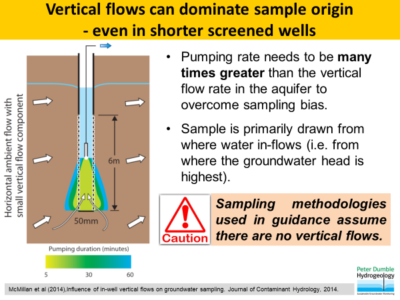
These two new papers from the Aussie researchers tackle this question. Part one of this blog focuses on the first of these, which examines the effects of intraborehole flow on groundwater sampling. Part two looks at a methodology for sampling and resolving the depth-specific chemistry of groundwater sampled in a flow stream.
What follows are a few notes paraphrased from the paper to draw out some of the key problems we face when interpreting water quality samples from long-screened wells and open boreholes.
There are also some detailed graphics and discussion within the referenced papers, which are worth taking time to read through. (Links to the original papers are included below.)
Paper 1:
Effects of intraborehole flow on purging and sampling long-screened or open wells. Groundwater 57 (2), 269-278).
Vertical hydraulic head gradients are ubiquitous in groundwater systems, consequently any unpumped well creates a short circuit for vertical flows between permeable zones connected by the well. This is known as intraborehole flow (IBF).
Over time, a plume of invading water (termed the “IBF plume”) develops in zones with lower head, displacing native groundwater.
Aside from the challenge of correctly apportioning water composition to its depth origin in the well, the presence of an IBF plume around a well can further complicate interpretation of chemical analyses by either exacerbating or masking the presence of a contaminant and substantially altering the mix of groundwater sampled.
If a long-screened or open well is left unpumped, it could take a long time to fully purge the resulting IBF plume.
When a well is pumped, water produced from zones at lower heads actually originates from zones with higher heads.
A permeability-weighted (“flow-weighted”) average sample desirable for contaminant studies (using short-screen wells) may not be achievable unless the pumping rate is high enough to overcome the prevailing flow in the well (caused by the head gradient).
The main content of the paper describes the results from a numerical model investigating the the complexity of in-well flow and mixing on well chemistry.
Conclusions agree with and go beyond the work of McMillan et al (2014) and others in the following respects:
The pumping rate must be at least an order of magnitude higher than the IBF rate to minimize hydraulic head bias in the sample and minimize the purge volume.
After an example 1,000-day unpumped period in a homogeneous system, purging an IBF plume required removal of at least three orders of magnitude more water than the common practice of three to five well volumes, i.e., it is often impractical to obtain a permeability-averaged sample by pumping.
However, and more practically, since an IBF plume resides only in lower head zones, native groundwater samples can be obtained within the flow stream without purging and are representative of the chemistry arising from the inflow zones.
Some practical observations
This paper reminds us of the need to be careful how we interpret samples collected from wells where vertical flows are occurring, whether they be short- or long-screened wells or open boreholes.
How to obtain usable information from such wells depends on your objectives and a good conceptual understanding of the situation, which we explore further in Part Two.
Sampling in Long-Screened and Open Boreholes (Part 2)
An alternative sampling strategy.
Here, we focus on the second of the two papers published in 2019, by an Australian research group led by David Poulsen. The work builds on earlier work by McMillan et al (2014) and many others.

Figure 1: Graphic illustrating the presence of two separate flow streams in a long-screen monitoring well (from Groundwater sampling course notes, JP Dumble, 2019)
Depth-resolved groundwater chemistry by longitudinal sampling of ambient and pumped flows within long-screened and open borehole wells. Water Resources Research, November 2019.
The following comments pertain to one aspect of the paper: that of sampling within ambient (unpumped) flow streams within long-screened wells (illustrated conceptually in Figure 1).
The problem:
The problem is summarized in these words from the authors:
“If a well intersects zones of variable concentrations,” the chemistry of a pumped sample “will be a composite of the inflows, which mix in the well.”
“Where depth-discrete concentrations are required, excessive mixing makes samples less useful and potentially misleading.”
“Depth-resolved water chemistry samples are critical to a wide range of groundwater investigations.”
Depth-resolved water quality samples can only be reliably obtained using short-screened monitoring wells targeted at specific depths, however, given their legacy, there is often no option other than to use longer-screened wells or open boreholes for sampling.
Whilst not recommending “the use of long-screened or open boreholes as sampling devices by design,” the authors describe in this paper an alternative sampling method that enables “more reliable depth-resolved estimates of groundwater chemistry” to be obtained from such wells when they already exist.
The ubiquious presence of ambient vertical flows within these wells combined with the longer screen lengths exclude the possibility of obtaining a permeability-weighted (or “flow-weighted”) average sample representative of inflow across the whole of the well screen. Hence the need to consider alternative sampling strategies.
Sampling methodology:
The authors focus on the results arising from samples collected in ambient (unpumped) flow conditions. They make the case that sampling within the well where vertical flow is naturally occurring can provide better sampling conditions than while pumping.
To put this approach in perspective, it is useful to know that the three wells used for research were between 195 and 203 mm (approx.8 inches) in diameter, drilled to depths of between 142 and 155 m. Screens were very long—between 76 to 121 m. Water level was between 22 and 27 m below ground level. Transmissivities ranged from 200 to 1300 m2/day.
Flow measurements were taken within the wells using an electromagnetic flow meter, which recorded ambient flows before sampling of up to 29 l/min (but more typically, less than 10 l/min). Both upward and downward flows were recorded.
Samples were collected using a low flow pump from three or four vertical positions in each well, corresponding to flow streams identified from the flow measurements.
By using a mass balance approach, the chemical concentration from each inflow zone was then calculated—providing an estimate for the depth-resolved chemistry at the inflow zone.
Conclusions on sampling in vertical ambient flow streams:
Sampling groundwater within a vertical flow stream in the well can be carried out without purging or pumping the well and can provide more “insightful data than sampling pumped flows.”
The chemistry of specific groundwater inflows can be estimated by measuring and sampling the vertical flow regime within the well.
It is difficult to sample native groundwater from groundwater outflow zones because water in these areas is displaced by large volumes for intraborehole flow (see Part One).
It is good to see new research picking up the challenge of how to practically sample long-screen wells and clearly presenting the steps needed to obtain a meaningful interpretation of the sample quality and its origin.
It is also very welcome to see the authors draw renewed attention to the importance of understanding the flow regime within the well and that flows need to be measured. Without flow measurement it would not be possible to resolve the concentration or origin of chemistry from the samples collected within the borehole.
Some practical observations
All sampling programs need to have clear sampling objectives Sometimes a mixed water sample is good enough, but if we’re trying to understand the origin of different water quality sources, whether due to contaminantion or natural chemistry variations, more information is needed in addition to that provided by the analysis of a single mixed “wellwater” sample (see for example Furlong et al., 2011).
At the present time, the tools for routinely deconvolving water chemistry in most groundwater investigations are not readily available. In particular, measuring flow in boreholes is fraught with problems, and equipment is a long way from being affordable or convenient to use, particularly in narrow diameter monitoring wells (sub 100 mm).
However, this does not mean we can ignore the science. Be wary if you suspect there are vertical flows in the groundwater system you are sampling, particularly if you are using conventional sampling methodologies. It is possible the resulting laboratory analyses could cause you to draw misleading interpretations.
Related Blogs
Screen Volume and Low Flow Groundwater Sampling https://in-situ.com/blog/screen-volume-and-low-flow-groundwater-sampling
Groundwater Sampling – Are we doing it right? https://in-situ.com/blog/groundwater-sampling-right
Screen Volume and Low Flow Groundwater Sampling https://in-situ.com/blog/screen-volume-and-low-flow-groundwater-sampling
References
+
Furlong B.V., et al, 2011. Using regional groundwater flow models for prediction of regional wellwater quality distributions. J. Hydrol, 398, 1-16. https://www.sciencedirect.com/journal/journal-of-hydrology/vol/398/issue/1
McMillan, L.A., et al, 2014. Influence of vertical flows in wells on groundwater sampling. J. Contam. Hydrol, 169, 50-61. http://dx.doi.org/10.1016/j.jconhyd.2014.05.005
Poulsen, D.L., et al, 2019a. Effects of intraborehole flow on purging and sampling long-screened or open wells. Groundwater 57 (2), 269-278). https://doi.org/10.1111/gwat.12797
Poulsen, D.L., et al, 2019b. Depth-resolved groundwater chemistry by longitudinal sampling of ambient and pumped flows within long-screened and open borehole wells. Water Resources Research. https://agupubs.onlinelibrary.wiley.com/doi/abs/10.1029/2019WR025713
©Peter Dumble 2020


Comments